About
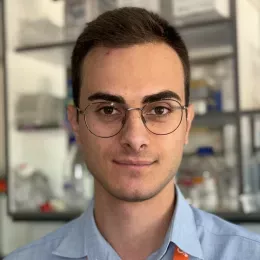
Angelo Pilotti completed his Bachelor of Science in Biotechnology at the University of Campania “Luigi Vanvitelli” in Italy. He conducted his thesis project in Biochemistry, entitled « The CRISPR-Cas9 method for the knock-out of the gene ZNF639 in human glioblastoma cells », under the supervision of Prof. Paolo Vincenzo Pedone and Prof. Ilaria Baglivo.
For his Master's in Molecular Biotechnology, he conducted a thesis internship in Medical Genetics at the Telethon Institute of Genetics and Medicine (TIGEM) in Italy. He worked in Dr. Alessia Indrieri's laboratory of Mitochondrial Medicine under the supervision of Prof. Vincenzo Nigro. His work investigated the modulation of two microRNAs (miR-181a/b) as a potential treatment for rare mitochondrial diseases, e.g., Leber Hereditary Optic Neuropathy (LHON). After completing his Master's at the University of Campania “Luigi Vanvitelli”, he continued working as a postgraduate research fellow at TIGEM.
In September 2024, he relocated to France after being awarded a Marie Skłodowska-Curie Actions (MSCA) scholarship as part of the Doctoral Network IMMERGE, under the European Union's Horizon Europe research and innovation program. He is currently a PhD student in Immunology in Dr. Philippe Pierre's laboratory of Dendritic Cell Biology at Centre d'Immunologie de Marseille-Luminy (CIML). His doctoral project focuses on investigating the interplay between intracellular stress responses (e.g., the Integrated Stress Response – ISR) and the onset of autoinflammatory and autoimmune diseases.
Angelo's research interests lie primarily in biochemistry and genetics, particularly in understanding the interactions of biomolecules within networks and their role in modulating gene expression. He is fascinated by the mechanisms underlying those processes and how their dysregulation can lead to disease.
Scientific project
The integrated stress response (ISR) is a cellular pathway activated by various biochemical triggers. It reduces global protein synthesis while promoting stress resolution and cell survival through the activation of different kinases of the eukaryotic translation initiation factor 2A (eIF2AK).
In immune imbalances, plasmacytoid dendritic cells (pDCs), monocytes, and B cells may fuel autoimmunity through the abnormal release of cytokines, type-I interferon (IFN), and autoantibodies. Recent research shows that ISR mediators, such as eIF2AK3 (PERK), can activate innate sensors (e.g., stimulator of interferon genes – STING) to induce type-I IFN production in response to nucleic acids or toxins. Notably, novel variants in genes encoding different eIF2A kinases and phosphatases have been identified in patients with autoimmune and autoinflammatory syndromes.
This project will investigate whether familial variants in the ISR genes may predispose individuals to disease.